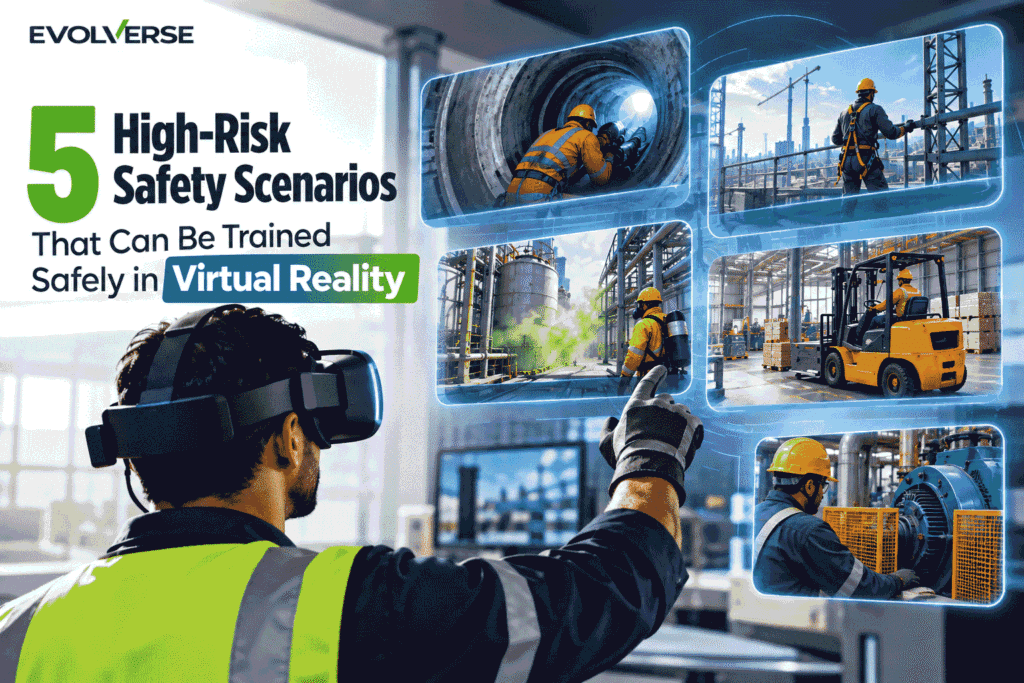
Think about how you would train someone to respond to a confined-space emergency.
You can’t fill a tank with toxic gas to see how they react.
You can’t push someone off a platform to test their fall protection, or spill a real chemical across the floor just to watch what happens.
Yet these are the situations where people need practice the most.
You can’t safely recreate a serious incident for training.
But you can recreate the decisions that prevent one, and that is where Virtual Reality (VR) comes in.
The Challenge of Training for High-Risk Work
Most high-risk training follows the same path: classroom, slides, videos, a demonstration. It works for knowledge.
What it rarely offers is the chance to experience a situation, decide, act, get it wrong, correct it and try again. Some scenarios are too dangerous, too expensive or too hard to repeat in real life.
Here are five where VR adds the most value.
1. Fire and emergency response
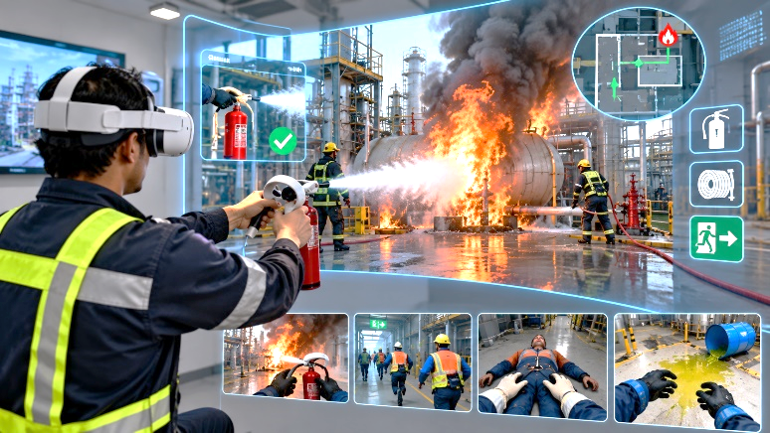
You are walking through a production area and notice smoke coming from a machine. What do you do first?
In a real fire, you have to recognise the emergency, raise the alarm, judge whether it is safe to step in, pick the right extinguisher, and know when to stop and evacuate. Traditional training usually means watching someone demonstrate how to use an extinguisher.
In Virtual Reality, you are inside the facility, and you choose: ignore it, raise the alarm and assess, or walk up to it without PPE. The scenario responds to whatever you pick.
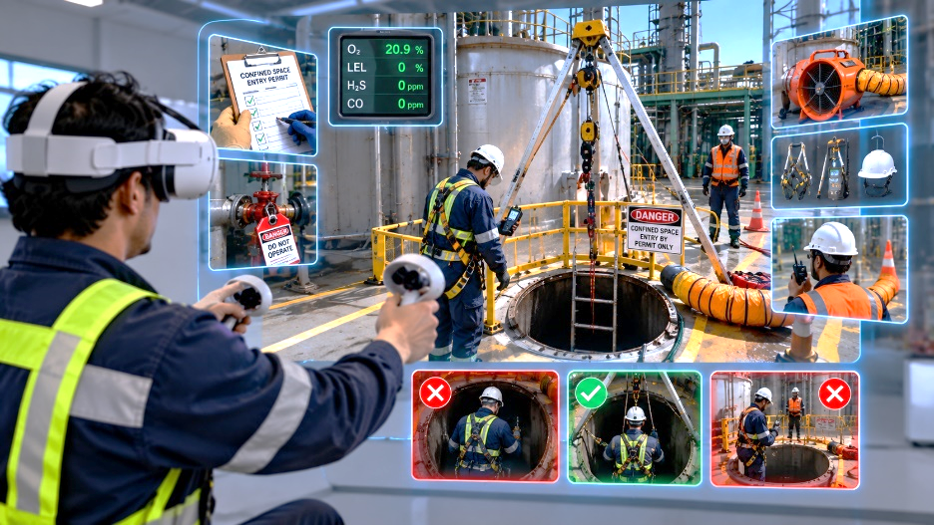
2. Confined space entry
A worker is about to enter a confined space. Everything looks normal. But there could be low oxygen, toxic gas, poor ventilation, missing isolation or no clear rescue plan. Would they notice before going in?
You can’t safely create these conditions in traditional training.
In VR training, the learner experiences the full entry sequence: permit, isolation, atmospheric testing, ventilation, PPE, communication and a standby person. Skip a step, and the system tells them straight away.
3. Work at height
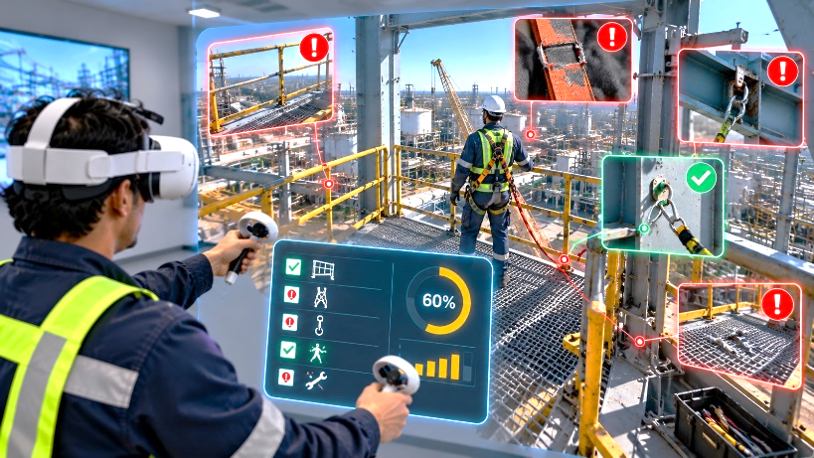
You are on an elevated platform, and the job looks routine. But is there a missing guardrail? A damaged harness? A poor anchor point, an unprotected edge, something that could fall on the people below?
Practicing hazard spotting at real height, with real consequences, isn’t an option.
In VR training, the learner inspects, identifies, decides, corrects and only then proceeds. Scoring makes it measurable, because you can see how many hazards each person actually found.
4. Lockout/Tagout (LOTO)
A machine has stopped, and maintenance needs to work on it. It seems simple, but is it actually safe? Electrical, hydraulic, pneumatic and stored energy can all be waiting, along with gravity and the risk of unexpected start-up.
You can’t expose people to a hazardous energy release to see if they follow the procedure.
In VR training, the learner identifies the energy sources, isolates, locks, tags, releases stored energy and verifies zero energy. If they lock out but forget to verify, VR can show the consequence safely and explain what went wrong.
LOTO isn’t just about knowing the procedure. It is about applying it every time, before anyone is exposed.
5. Chemical spill response
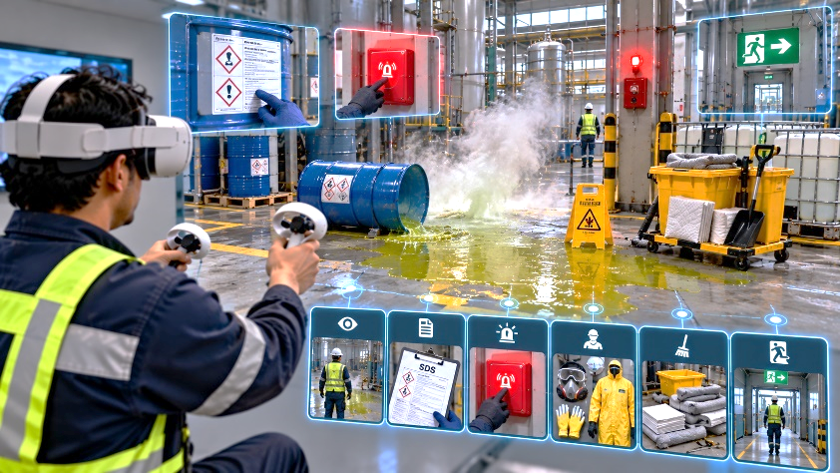
A container falls. Liquid spreads across the floor, and there is a strange smell. What now?
Approach it? Identify the chemical? Check the SDS? Raise the alarm? Choose PPE, use a spill kit, evacuate? The order matters, and so does recognising when the situation is beyond your capability.
VR training lets learners feel the pressure of a spill unfolding in real time without any exposure to the chemical.
The Value of a Safe Place to Make Mistakes
At work, a wrong decision may cause an incident. In VR, it produces feedback and a second chance. A wrong extinguisher, a skipped gas test or a broken LOTO sequence becomes a lesson, not an injury.
Choosing the Right Topics for VR
VR does not replace classroom, practical or on-the-job training. It adds a layer of experience and practice. It delivers the most where risk is high, rehearsal is difficult, decisions are critical, and scenarios can be repeated. Fire, confined space, work at height, LOTO and chemical emergencies meet all four tests.
Moving from Knowing to Doing: Where Safety Learning Goes Next
Safety training is shifting from “here is what you need to know” to “here is the situation, so what would you do?” The next stage is data: seeing how people decide and perform, then improving on it.
We cannot recreate every workplace emergency. We can recreate the decisions people may face, and give them the chance to practise long before the real moment arrives.