
Introduction
Workplace safety is not just about having policies, procedures, and protective equipment in place. What really matters is whether these measures work in practice. Regular safety audits help organisations identify gaps, verify that hazards are properly controlled, and ensure safety procedures are followed in day-to-day operations.
IS 14489:2018 — Occupational Health and Safety Audit: Code of Practice provides guidance on planning and conducting safety audits, examining workplace practices and records, identifying gaps in safety management, and documenting audit findings to improve OH&S performance across various workplaces, including Major Accident Hazard (MAH) industries.

Understanding IS 14489:2018
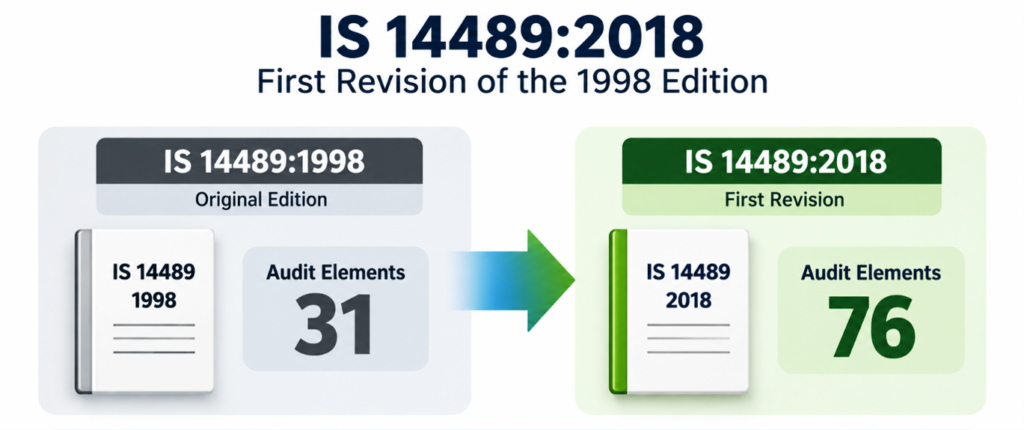
IS 14489:2018 is the first revision of the original 1998 edition. The revised standard expanded the scope of the audit framework, increasing the number of audit elements from 31 to 76 to cover a wider range of occupational health and safety aspects.
The standard helps organizations review various aspects of their OH&S management systems, assess how effectively safety measures are implemented, and identify areas that need improvement to strengthen overall workplace safety.
The standard also helps organizations verify compliance with applicable health and safety laws and regulations, including relevant statutory requirements under legislation such as the Factories Act, 1948.
Key Areas Covered Under IS 14489:2018
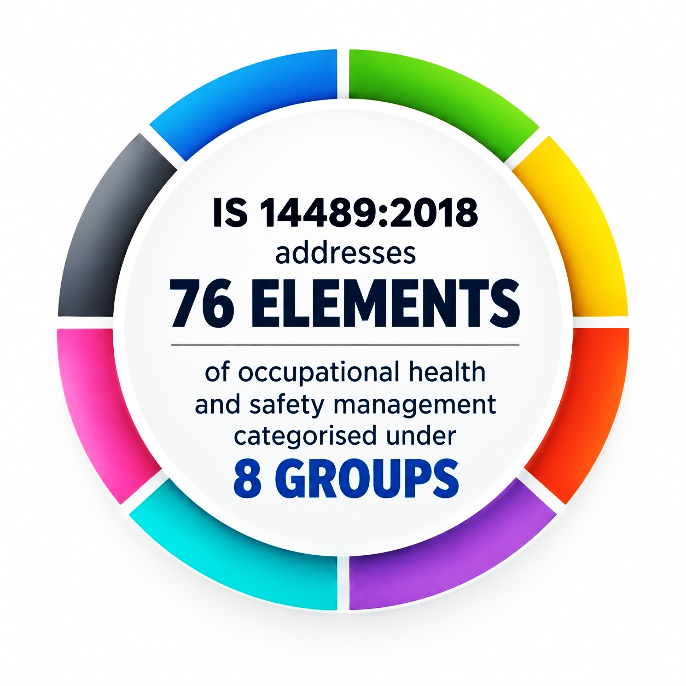
The IS 14489:2018 standard addresses 76 Elements of occupational health and safety management categorised under 8 groups as follows:
| = | Focus | Elements | Marks |
|---|---|---|---|
| A-1 | OH&S Management | OH & S Policy, Safety manual, Plant modification procedure, Contractors’ safety system, Medical management of accidents, Employee selection and placement, Statutory licences, approvals and records, Hazard identification and job safety analysis, Safety training, OH & S organisational set-up, Standard Operating Procedures (SOP), Work permit system, Plant design and layout, Management of emergencies (natural/man-made), Safety culture, Motivational and promotional measures for OH & S, Product safety, Change management | 18 |
| A-2 | Physical Hazards | Housekeeping, Machine and general area guarding, Material handling, Safety in storage and warehousing, Hazards from radiation sources, Electrical safeguarding, Hazard assessment of new equipment, Control measures for specialised industrial hazards like work at height and work in confined space | 8 |
| A-3 | Chemical Hazards | Transportation of hazardous substances, Storage of hazardous substances, Material Safety Data Sheet (MSDS), Labelling and colour coding, Handling of hazardous substances, Spill control measures, Gas cylinders, Hazardous waste management | 8 |
| A-4 | Fire and Explosion Hazards | Organisational setup for firefighting, Built-in safety in Safety in Electric Circuits and Equipment, Built-in safety in civil design and construction, explosive substances, Fire safety in handling flammable and explosive materials, Passive and active fire protection system, Portable Fire Extinguishing System, Fire drill, Static electricity and lightning, Fire detection and alarm system, Fixed fire extinguishing system, Firefighting equipment and facilities, Firefighting training | 13 |
| A-5 | Industrial Hygiene and Occupational Health | Vibration, heat stress, non-ionising radiation, ventilation, illumination and noise, First aid facilities and occupational health centre (OHC), Personal protective equipment and emergency equipment, Work place monitoring for hazardous chemicals, Periodic medical examination, Occupational disease | 6 |
| A-6 | Accident and Incident Reporting, Investigation and Analysis | Accident reporting, Accident investigation, Analysis of accidents, Implementation of recommendations, Reporting and investigation of near -miss incidents | 5 |
| A-7 | Emergency Preparedness (On-site and Off-site) | Site-specific details, Duties and responsibilities of key personnel, Identification of emergencies and accident scenarios, Declaration and termination of emergency, Resources-evacuation / transport, Communication facilities, Medical care, Updation of emergency plan, Periodic drills/exercises, Training of plant personnel, Public awareness programmes, Mutual-aid programme, Emergency control centre | 13 |
| A-8 | Safety Inspection | Inspection programme, Safety Related Deficiency (SRD) Report, Safety inspection records, Methodology and inspection team, Compliance of recommendations | 5 |
Audit Frequency: How Often Should IS 14489 OH&S Audits Be Conducted?
It is recommended to have a combination of internal and external OH&S audits.
- Internal audits: Generally conducted once a year.
- External audits: Generally conducted once every two years or as required by applicable law.
The frequency of safety audits should also depend on the organization’s risk level and safety performance. Reviewing accident and dangerous occurrence records helps identify high-risk areas and activities. If these records indicate increased risks, internal audits should be conducted more frequently to ensure that potential hazards are properly addressed.
Organizations should verify the applicable legal and sector-specific requirements when establishing their audit schedules.
IS 14489 OH&S Audit Methodology: A Step-by-Step Overview
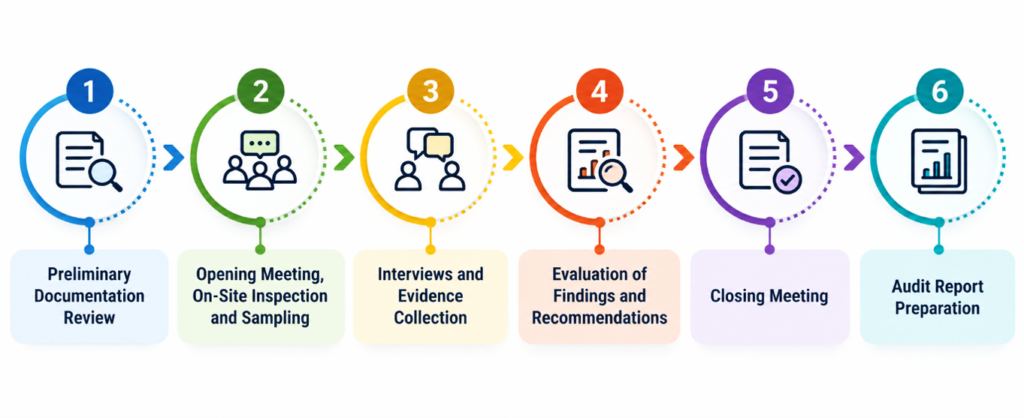
An IS 14489 audit requires a structured approach to ensure that relevant information is collected, evaluated, and documented.
Step 1: Preliminary Documentation Review
Before conducting the audit, review the organization’s safety policies, procedures, risk assessments, previous audit reports, and other relevant documents to understand existing safety arrangements and identify areas that require attention.
Step 2: Opening Meeting
Coordinate with the relevant representatives to discuss the audit objectives, scope, methodology, schedule, and responsibilities, ensuring that everyone understands the audit process and their respective roles.
Step 3: On-Site Inspection and Sampling
Observe workplace conditions and operational activities against the applicable IS 14489:2018 audit elements to verify compliance with OH&S requirements, assess the effectiveness of safety controls, and identify gaps in their implementation.
Step 4: Interviews and Evidence Collection
Interact with employees, supervisors, and safety personnel, and verify relevant records and other objective evidence against the applicable IS 14489:2018 audit elements to assess the implementation and effectiveness of OH&S arrangements.
Step 5: Evaluation of Findings and Recommendations
Review the evidence collected against the applicable IS 14489:2018 audit elements, identify nonconformities and good practices, and recommend suitable corrective and preventive actions to improve the organization’s OH&S performance.
Step 6: Closing Meeting
Present the significant audit findings to the relevant stakeholders, explain the identified gaps against the applicable IS 14489:2018 audit elements, and discuss practical recommendations to improve safety performance and address the findings.
Step 7: Audit Report Preparation
Prepare a structured audit report documenting the audit methodology, evidence reviewed, findings, conclusions, and recommendations in accordance with the applicable IS 14489:2018 audit requirements, including identified nonconformities and suggested corrective actions.
What Should an IS 14489 OH&S Audit Report Contain?
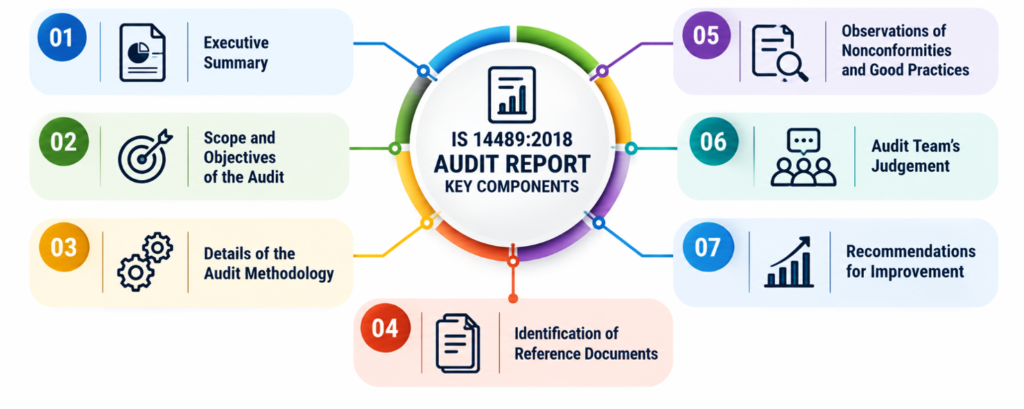
An audit report communicates the outcome of the audit and provides a basis for improvement. key report components include:
- Executive summary.
- Scope and objectives of the audit.
- Details of the audit methodology.
- Identification of reference documents.
- Observations of nonconformities and good practices.
- Audit team’s judgement.
- Recommendations for improvement.
A well-structured, evidence-based audit report helps management understand the organization’s OH&S performance, prioritise identified gaps, and decide on the necessary corrective actions for continual improvement.
What Records Should Be Examined During an IS 14489 Safety Audit?
- OH & S policy
- Safety organisation chart
- Training records on fire safety and first aid
- Record of plant safety inspections
- Accident investigation reports
- Accidents, dangerous occurrences and near-miss incidents – statistics and analysis
- Record of tests and examinations of equipment and structures as per statutes
- Standard Operating Procedures (SOP) for various operations
- Record of work permits
- Record of work environment monitoring (flammable, toxic and explosive substances
- Maintenance, testing and calibration records of fire detection and firefighting equipment;
- Medical records of employees;
- Records of industrial hygiene surveys (noise, ventilation, illumination, dust, etc.
- Material Safety Data Sheets (MSDS)
- On-site emergency plans and records of Mock Drills
- Records of storage of hazardous solid waste and its disposal
- Records of gaseous emissions and effluent discharges to the environment
- Housekeeping inspection records
- Minutes of safety committee meetings
- Statutory licences and approvals
- Records of any modifications carried out in plant or process
- Maintenance procedures and records
- Instrumentation and equipment calibration and testing records
- Planned shutdown maintenance procedures
- In-service inspection manuals, records including that of material handling
- OH & S budget
- Inspection books and other statutory records
- Records of previous audits and safety analysis
- Procedures for safe transportation of hazardous substances
- Calibration records
- Records for breakdown of plants during the process of manufacture
- Records for waste material generated and their disposal
- SOP for disposal of waste materials
- Records for issue of PPE items to the personnel
- working in process building
The relevance of each record depends on the organization’s activities, hazards, audit scope, and applicable legal requirements.
How Can IS 14489 OH&S Audits Improve Workplace Safety?
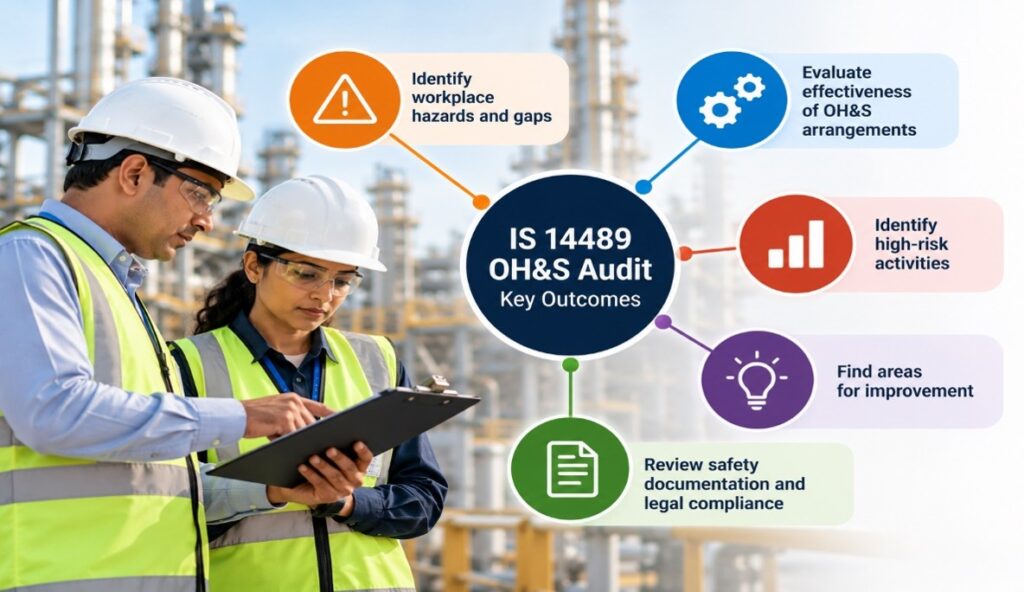
When carried out effectively, IS 14489 OH&S audits help organisations to:
- Identify workplace hazards and gaps in existing safety controls.
- Evaluate the effectiveness of OH&S management arrangements.
- Identify recurring incidents and high-risk activities.
- Review safety documentation and assess compliance with applicable legal requirements.
- Find areas where safety procedures and workplace practices need improvement.
- Make informed decisions on corrective and preventive actions.
- Strengthen accountability and support continual improvement in safety performance.
The real value of a safety audit lies not just in identifying gaps, but in ensuring that the findings are addressed, corrective actions are implemented, and their effectiveness is verified.
Conclusion
IS 14489:2018 provides a systematic approach to assessing occupational health and safety arrangements in industrial workplaces. It covers key aspects such as management commitment, hazard identification, incident analysis, emergency preparedness, documentation, and audit reporting. By evaluating these areas, organizations can identify gaps, strengthen safety controls, and improve workplace risk management.
Strengthen Your Safety Systems with EVOLVE
Planning an IS 14489:2018 Safety Audit for Your Organization?
Enquire NowPartner with EVOLVE for a systematic and professional occupational health and safety audit.
With experienced, government-certified safety auditors, EVOLVE helps organizations assess workplace safety practices, identify gaps, evaluate compliance, and implement meaningful improvements.
Make your next safety audit count.
📩 Connect with EVOLVE to discuss your IS 14489:2018 audit requirements.