
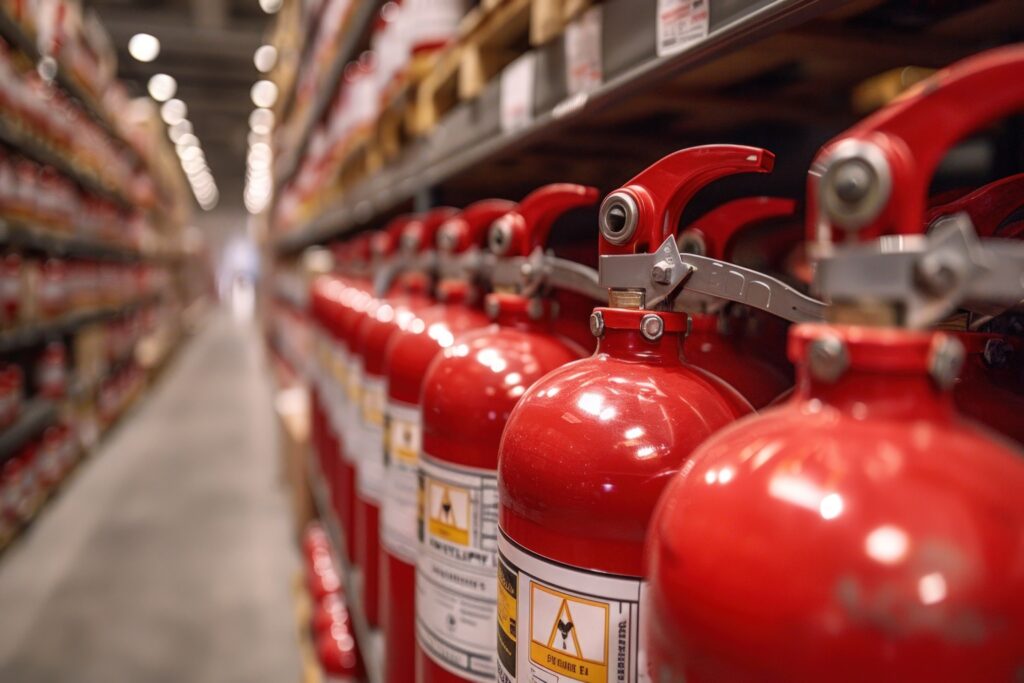
Just imagine it’s a normal working day.
All of a sudden, the fire alarm sounds. Employees rushed to the nearest emergency exit, but found it obstructed by stored materials. Some employees tried to use fire extinguishers, but found them not operational due to a lack of maintenance.
These unsafe conditions can convert a small fire into a major emergency. Most people do not recognise the consequences of such conditions unless they witness a real emergency.
This is where Fire and Life Safety Audits (FLS) become essential. Fire and Life Safety Audits help to discover hidden risks that can go unnoticed during routine operations—before they lead to a serious emergency.
In almost all workplaces, such as manufacturing plants, warehouses, laboratories or common offices, there are certain common fire safety risks. In this blog, we will review the most common fire audit observations, discuss why they matter, and explore practical ways to prevent fire incidents and keep your workplace safer.
What Is a Fire and Life Safety Audit?
Most people think that a Fire and Life Safety Audit is just a check to witness whether fire-fighting equipment is available at the workplace or not. But in reality, it is beyond that.
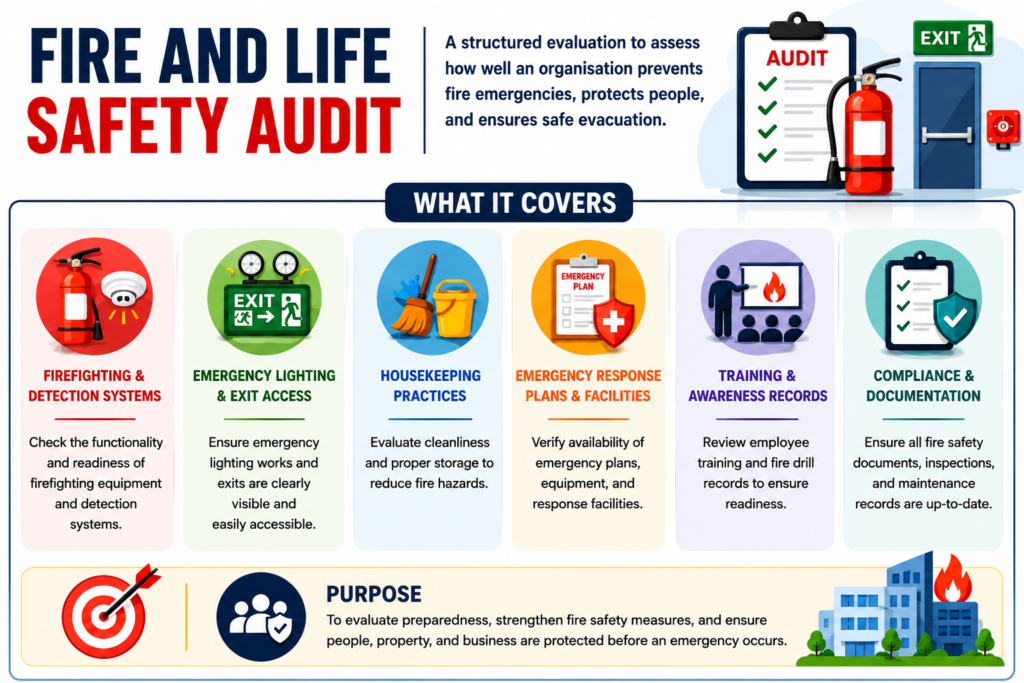
A Fire and Life Safety Audit is a structured methodology to assess how efficiently an organisation can prevent a fire emergency, recognise them quickly, protect its employees, and arrange a safe evacuation in case of emergency.
During an audit, auditors would assess various parameters, such as the operation of firefighting and detection systems, arrangements for emergency lighting, easy access to emergency exits, housekeeping practices, availability of emergency response plans and facilities, training records, etc.
The purpose of the audit is not to find faults or place blame on anyone. Rather, it is to evaluate the preparedness in place before an emergency occurs.
Why Fire Safety Audits Matter More Than Ever
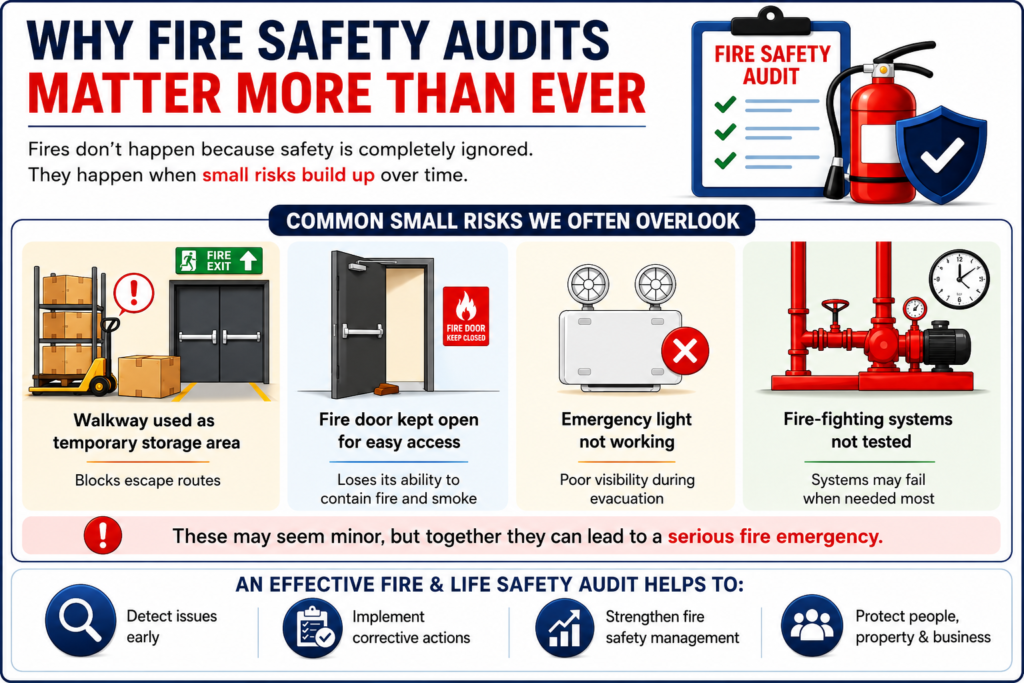
In any workplace, a fire emergency breaks out not because the organisation completely fails to implement safety measures. Rather, it occurs because small risks and issues accumulate over a prolonged time.
For example,
A walkway used as a temporary storage area.
A fire door is kept open to allow easy access
An emergency light is not working or is not sufficient
Testing of fire-fighting systems is not done due to the busy operation schedule.
In general, these things may seem like minor issues. But combined, they can lead to a serious fire emergency.
An effective fire and life safety audit will help organisations to detect these issues early, implement corrective actions, and improve the fire safety management system.
1. Emergency Exits That Are Not Really Emergency Exits
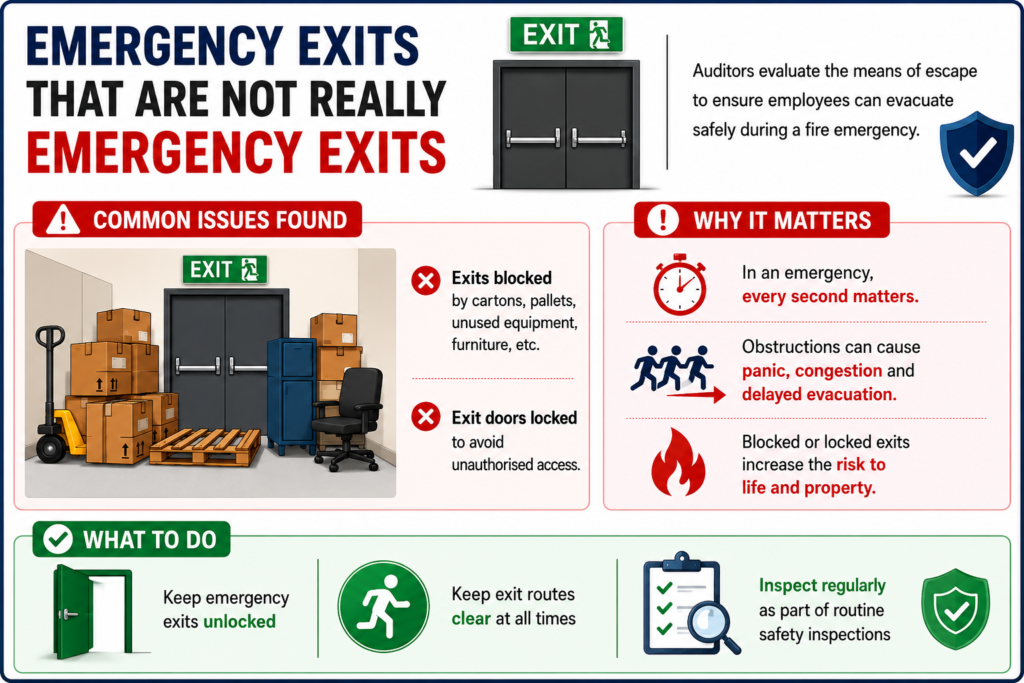
One of the important factors auditors evaluate during an audit is the means of escape.
Unfortunately, in many workplaces, emergency exits are blocked with obstructions like cartons, unused equipment, pallets, furniture, etc. In some places, even exit doors are locked to avoid unauthorised access.
In general, these conditions may seem harmless. But in case of an emergency, every second matters. During an emergency, employees will not have time to clear obstructions or look for an alternative route to evacuate. This condition could lead to panic, congestion, and delayed evacuation.
To avoid this, emergency exits should always be kept unlocked, clear and inspected periodically as part of regular inspections.
2. Fire Extinguishers That Cannot Be Used When Needed
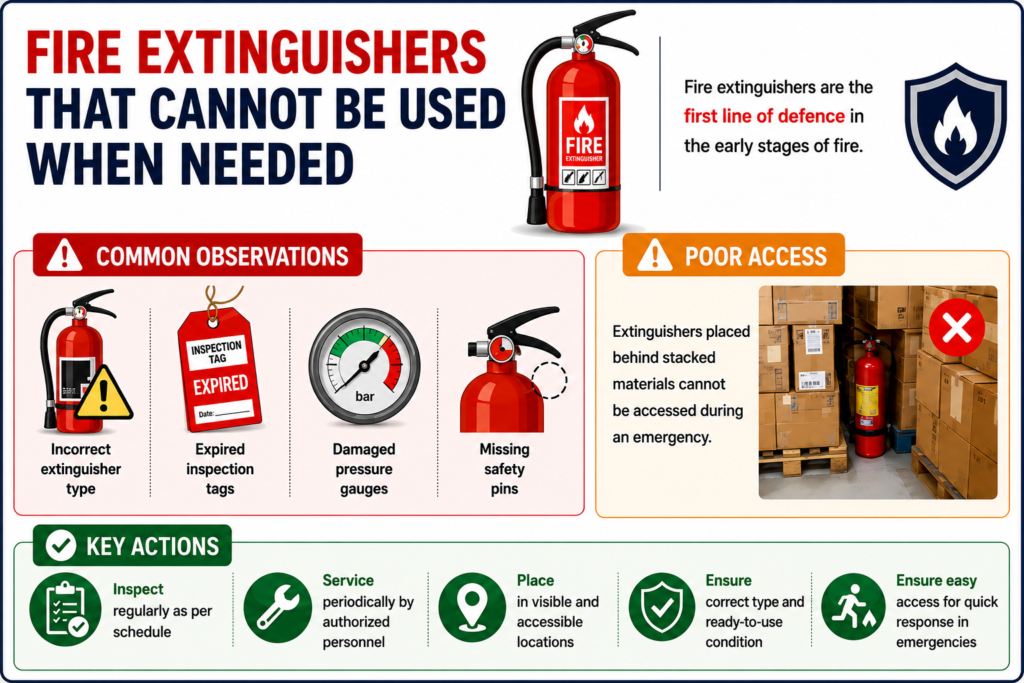
Fire extinguishers are generally available in almost every workplace. However, whether every extinguisher is in proper operating condition is a big question mark.
Some common observations during audits include incorrect extinguisher types, expired inspection tags, damaged pressure gauges, absence of safety pins, etc.
At one worksite, an extinguisher was placed at the back of stacked materials. Though an extinguisher was physically available, accessing it during an emergency is almost not possible.
Fire extinguishers are usually considered a legal requirement; however, they are the first line of defence in the early stages of fire. Periodic servicing, inspection, proper placement and easy access support in effective response during emergencies.
3. Fire Alarm Systems That Are Never Tested
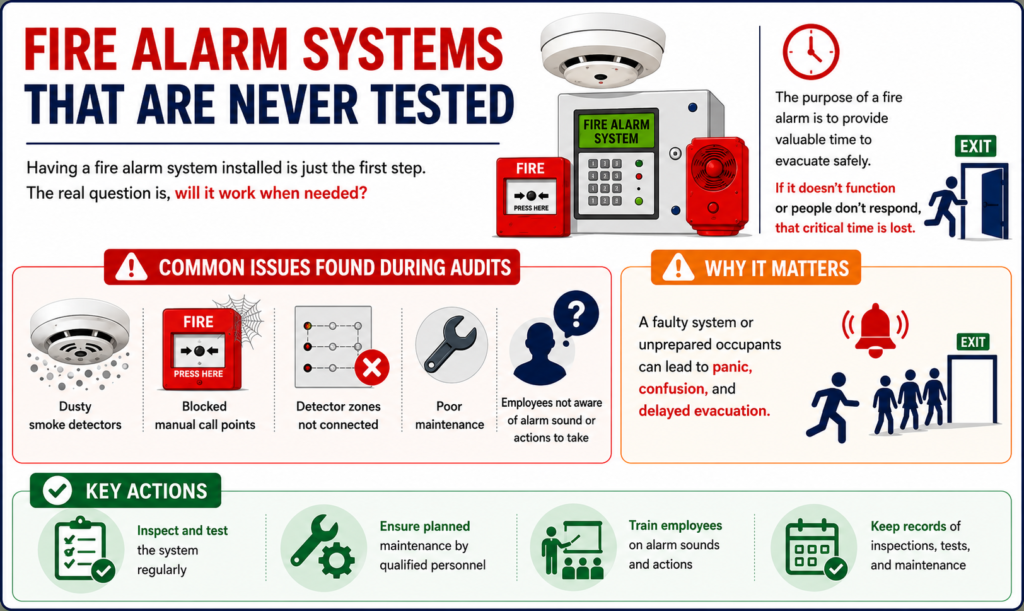
Having a fire alarm system installed and available at the site is only the first step. The real question is, will it function efficiently when needed?
During audits, it is usual to find smoke detectors with dust, blocked manual call points, detector zones not connected, and poor maintenance. In certain cases, employees are not even aware of the fire alarm sound and the immediate actions they should take when it activates.
The purpose of a fire alarm is to provide valuable time to the occupants to evacuate safely during emergencies. If the fire alarm doesn’t function or if occupants don’t respond properly, that critical time is lost.
Regular inspection and testing, planned maintenance, and employee training are just as important as installing the system itself.
4. Poor Housekeeping: A Hidden Fire Hazard
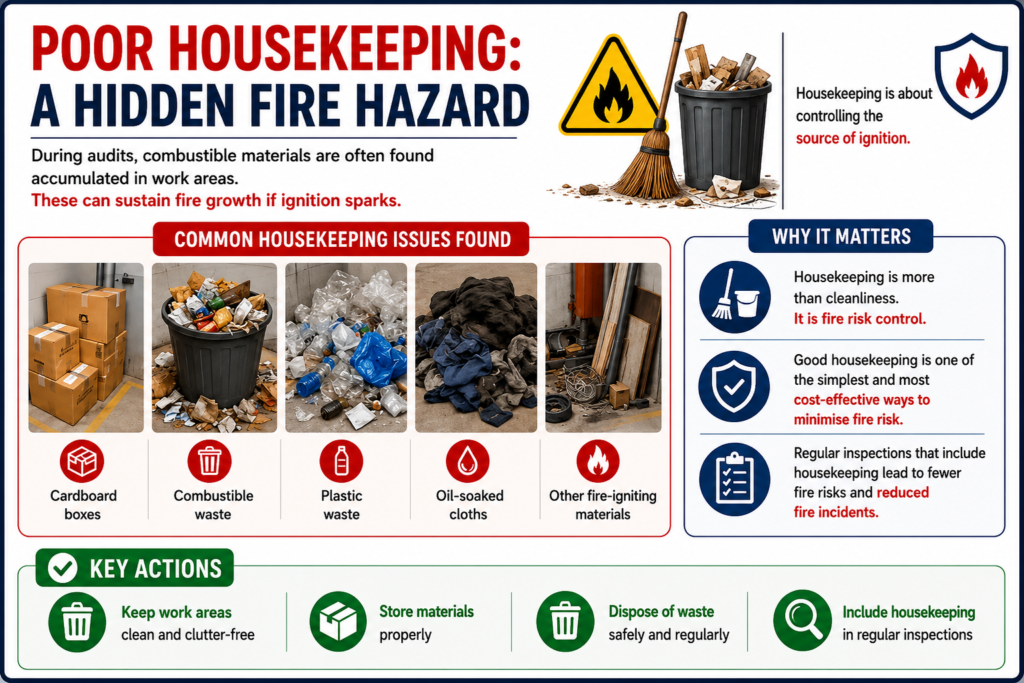
Housekeeping is usually related to cleanliness, but from a fire safety point of view, it’s about controlling the source of ignition.
During audits, cardboard boxes, combustible waste, plastic waste, oil-soaked cloths, and other fire-igniting materials are often found accumulated in work areas. These materials can sustain fire growth if ignition sparks.
Housekeeping is not only about maintaining a clean workplace. It is one of the simplest and cost-effective ways to minimise fire risk.
Organisations that include housekeeping in regular inspections often experience fewer fire risks and a significant reduction in fire incidents.